What Is PancakeSwap? The Complete Guide for 2026
PancakeSwap is the largest decentralized exchange on BNB Chain and one of the earliest automated market makers (AMMs) in DeFi. It started in 2020 with a "yield farming + fork" model, survived multiple cycles, and now runs v2, v3 and Infinity pools across multiple chains.
The October 2026 "The Flip" governance proposal puts the economic model on the table: give 88% of v3 and Infinity trading fees to liquidity providers, cut CAKE emissions further, and keep v2 buyback-and-burn. This article explains how PancakeSwap works, what The Flip changes, and what it means for LPs and CAKE holders.
Key Takeaways
- PancakeSwap is a decentralized exchange (DEX) on BNB Chain, launched in 2020, using AMM pools instead of an order book.
- Products include swaps, liquidity, farms, Syrup pools, CAKE staking, lottery, prediction markets and perpetuals.
- The Flip proposal gives 88% of v3 and Infinity fees to LPs and 12% to the treasury, and cuts cumulative emissions by about 69%.
- For LPs, the higher fee share is offset by lower emissions and impermanent loss; for CAKE holders, the narrative is scarcity, not yield.
What Is PancakeSwap?
PancakeSwap is a decentralized exchange built on BNB Chain. It does not match buyers and sellers through an order book; it uses liquidity pools. Users deposit two tokens into a pool, and traders trade against the pool according to a formula. In return, liquidity providers (LPs) earn a share of trading fees.
The protocol launched in 2020 and became the default DEX for BNB Chain users thanks to low fees and fast confirmations. The native token CAKE initially rewarded liquidity miners. PancakeSwap later added farms, Syrup pools, staking, lottery, prediction markets and perpetuals, turning from a single exchange into a full DeFi suite.
PancakeSwap has also expanded beyond BNB Chain, deploying on Ethereum, Arbitrum, Base, zkSync, Linea and other networks. The core experience stays the same: connect a wallet, swap tokens, or provide liquidity to earn fees.
How PancakeSwap Works: v2, v3 and Infinity
PancakeSwap has three generations of pools with different designs.
| Pool type | Design | Best for | Fee |
|---|---|---|---|
| v2 | Constant product AMM; liquidity spread across the entire price range | Long-tail tokens, simple market making | 0.25% per trade |
| v3 | Concentrated liquidity; LPs choose a price range | Active management, stablecoin pairs, capital efficiency | 0.01% to 1% tiers |
| Infinity | Concentrated liquidity + hooks + singleton contract design | Advanced pools, custom logic, high volume | Set per pool |
Fees and pool designs may change; check pool details before adding liquidity.
Concentrated liquidity is the key upgrade. In v2, capital is spread from 0 to infinity, and most of it is never used; in v3 and Infinity, you can concentrate capital in a price range. Fees are higher while the price stays in range, and impermanent loss is larger when it breaks out.
Infinity adds hooks: custom logic executed before and after swaps, enabling dynamic fees, limit orders or liquidity management. By the end of 2026, Infinity's cumulative trading volume had exceeded $150 billion, making it a major trading engine.
Product Stack
- Swap: trade tokens on supported chains, with slippage and price impact limits.
- Liquidity: provide two-sided liquidity to v2, v3 or Infinity pools and earn fees.
- Farms: stake LP tokens to earn CAKE emissions, usually with boosts and multipliers.
- Syrup pools: stake CAKE to earn partner tokens or other rewards.
- CAKE staking: lock CAKE for veCAKE-style governance and a share of revenue.
- Prediction and perpetuals: trade event outcomes or leveraged positions, with a different risk structure.
- Lottery and NFT: legacy interactive products in the ecosystem that still exist.
Many products are convenient, but they also mean PancakeSwap is no longer "one product, one risk." Stablecoin swaps, long-tail meme coin pools and leveraged perpetuals have completely different downside risks.
CAKE Tokenomics and The Flip
CAKE started as an inflationary farm token. Tokenomics 3.0 in April 2025 cut daily emissions by about 44%, from roughly 40,000 to roughly 22,500. The Flip, under discussion in October 2026, cuts emissions further and directs more fees to LPs.
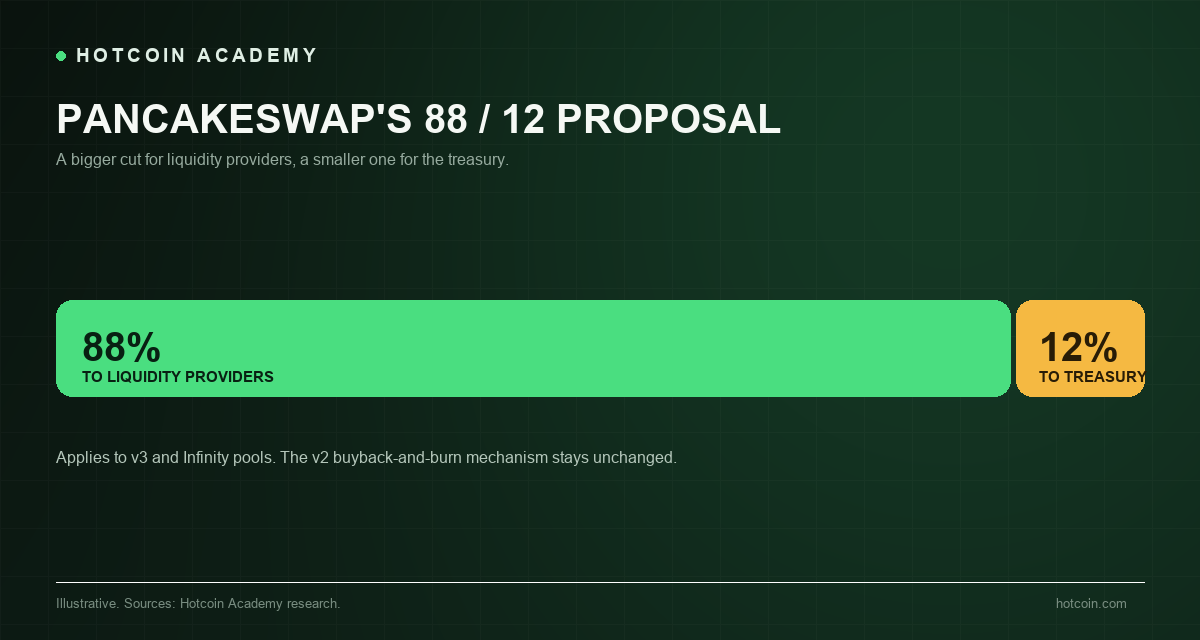
Figure: The Flip allocates 88% of v3 and Infinity fees to liquidity providers.
The proposal has three main points. First, 88% of v3 and Infinity trading fees go to LPs and 12% to the treasury. Second, the v2 fee structure — including the CAKE buyback-and-burn — stays unchanged. Third, after the cuts, cumulative emissions fall by about 69%.
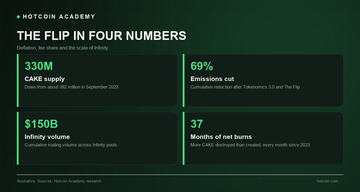
Figure: The supply, emissions, volume and burn numbers behind The Flip.
| Metric | Change | Meaning |
|---|---|---|
| LP fee share (v3/Infinity) | Proposed 88% | Higher LP revenue, lower treasury revenue |
| Treasury share | Proposed 12% | For development, partnerships or future burns |
| Cumulative emissions cut | About 69% | Less new supply entering the market |
| CAKE supply | About 330 million | Down from about 392 million in September 2023 |
| Months of net burns | 37 months | Burns consistently exceed new issuance |
| Infinity cumulative volume | Over $150 billion | The new pool design is being used in practice |
The Flip was still a proposal in October 2026, and parameters may change before the formal vote.
For LPs, the trade-off is clear: a higher fee share but fewer CAKE rewards. Whether it pays off depends on trading volume and how long capital stays in range. For CAKE holders, the narrative is scarcity: lower emissions and continuous burns reduce supply, but do not guarantee a higher price.
How to Use PancakeSwap
The basic process is simple, but every step has costs and risks.
- Prepare a wallet: use a self-custody wallet that supports BNB Chain, such as MetaMask or Trust Wallet. Store the seed phrase offline.
- Prepare BNB: you need BNB for gas, plus the tokens you want to trade or provide liquidity for.
- Connect to the official site: pancakeswap.finance. Bookmark it; fake sites are common.
- Swap or add liquidity: check slippage, price impact and pool fees before signing.
- Manage positions: monitor price range, fee income and impermanent loss; exit or adjust when the thesis changes.
If you provide liquidity, start with pairs you understand and ranges you can tolerate. High APR on volatile pairs usually compensates for the risk of the token falling, rather than being free yield.
Fees and Risks
PancakeSwap swap fees depend on the pool: 0.25% for v2, and 0.01% to 1% for v3 depending on the fee tier. Part goes to LPs, part to the treasury, and for v2 part is used for CAKE buyback-and-burn. Besides swap fees, you also pay network gas and slippage.
| Risk | Meaning | How to manage |
|---|---|---|
| Impermanent loss | The LP position may underperform simply holding the two tokens | Use stablecoin pairs, or actively manage a narrow range |
| Smart contract risk | Pools, farms or hooks may have bugs | Prefer audited pools with high TVL, and diversify |
| Token risk | Long-tail tokens may go to zero or rug | Research the token and avoid low-liquidity pools |
| Emissions risk | High yield may be offset by a falling CAKE price | Compare APR in token terms, not just dollars |
| Regulatory risk | DeFi access varies by jurisdiction | Check local rules and platform restrictions |
No risk framework can eliminate losses; it can only help you control their size.
How to Evaluate a Pool Before Depositing
Until you understand where the yield comes from, APR is the least useful number on the screen. Before adding liquidity, look at four things.
- Volume and TVL: pools with high liquidity and low volume generate little fee income; a high ratio may be real demand or mercenary capital.
- Range width: narrow ranges earn more while the price stays in range, and suffer larger impermanent loss when it breaks out.
- Token quality: if one side is a low-liquidity long-tail token, the yield compensates for exit risk, not free income.
- Emission share: split APR into fees and CAKE rewards. If most of it is emissions, returns depend on the CAKE price.
A good habit is to write down "within which price range does this position still make sense." If you cannot answer, you are not market making; you are making a directional bet in a more complicated way.
What to Watch in 2026
The Flip is the main governance story, but not the only variable. Watch whether the 88% share survives community feedback, whether LP deposits and volume actually rise after changes, and whether the 37 months of net burns continue as volume shifts from v2 to v3 and Infinity.
The broader environment matters too. In a market with lower risk appetite, DEX volume falls, emissions make up a larger share of LP returns, and CAKE's deflationary narrative gets tested. PancakeSwap's strength is BNB Chain distribution and continuous iteration; its weakness is competing with Uniswap, Aerodrome and a long list of concentrated-liquidity DEXs at the same time.
Common Misconceptions
- Looking only at the highest APR without checking which token the rewards are paid in.
- Providing liquidity for a token you would never hold on its own.
- Ignoring impermanent loss because the fee number on the dashboard is positive.
- Clicking a search ad for a fake site that looks like PancakeSwap.
FAQ
What is PancakeSwap? PancakeSwap is a decentralized exchange on BNB Chain (and several other networks) that uses automated market maker pools. Users can swap tokens, provide liquidity, join farms, stake CAKE and use other DeFi products.
What is The Flip? The Flip is a 2026 governance proposal: give 88% of v3 and Infinity trading fees to LPs and 12% to the treasury, and cut CAKE emissions further. It was still under discussion in October 2026.
Is PancakeSwap safe? PancakeSwap is one of the most-used DEXs and has been audited, but DeFi still carries smart contract, liquidity and token risks. Use audited pools, avoid unknown tokens, and do not put in funds you cannot afford to lose.
What is impermanent loss? Impermanent loss is the value gap between "putting two tokens into a pool" and "simply holding both tokens." When the price ratio changes, the LP position may be worth less than simply holding; exiting at the wrong time realizes the loss.
How do you make money on PancakeSwap? The main ways are providing liquidity to earn fees, farms to earn CAKE emissions, Syrup pool rewards and CAKE staking. Each has different risks; compare returns with fees and impermanent loss included.
Conclusion
PancakeSwap grew from a farm-token fork into a multi-product DEX with real fee revenue and a serious governance process. The Flip is a bet: more for LPs, fewer emissions, a more durable protocol.
For users, the key is to separate "the product" from "the token." Swapping on PancakeSwap is one decision; holding CAKE or providing liquidity is another, with completely different risks. You can track CAKE and BNB market data on Hotcoin's price pages.
Risk notice: This article is for educational reference only and is not investment advice. Providing liquidity and holding CAKE involve smart contract, market and impermanent loss risks, and you may lose all of your principal.
Recommended
View more