What Is the NVDA Stock Split? How Stock Splits Affect Share Prices
NVIDIA (NASDAQ: NVDA) completed a 10-for-1 stock split in June 2024, bringing its share price from about $1,200 down to about $120. This was the sixth and largest split in the company's history; if all splits since 2000 are accounted for, one original share has become 480 shares.
A stock split does not change a company's value, but it does change the per-share price, earnings per share, dividends, and options contracts. Using NVIDIA as an example, this article breaks down how stock splits work, their short- and long-term impact on share prices, and the misconceptions investors most often have.
Key Takeaways
- A stock split divides one share into multiple shares on a proportional basis; the share price falls proportionally, while market cap, ownership percentage, and voting rights remain unchanged.
- NVIDIA completed a 10-for-1 split on June 10, 2024, bringing its share price from about $1,200 to about $120; cumulative splits since 2000 amount to 480-for-1.
- Split announcements often bring a positive short-term reaction, but long-term share prices are still determined by revenue, earnings, and valuation; a split itself creates no value.
- After a split, earnings per share, dividends, and options strike prices are adjusted proportionally; most tax regimes do not treat a split as a taxable disposal, but cost basis calculation depends on local rules.
What is the NVDA stock split?
A stock split is when a company divides its existing shares into more shares on a proportional basis. In NVIDIA's 10-for-1 split, for example, every share a shareholder held became 10 shares; at the same time, the per-share price was adjusted to one-tenth of its previous level. A stock split does not involve the company issuing new shares to raise capital, nor does it change shareholders' ownership percentages in the company.
The core logic of a stock split is "slicing a pizza": the pizza stays the same size, it is just cut into more slices. The company's market cap, assets, liabilities, and earnings are all unchanged by the split; what changes is the price and quantity of each "slice." For NVIDIA, the 10-for-1 split made it easier for more employees, retail investors, and dollar-cost-averaging investors to afford a single share.
It is important to distinguish a "stock split" from a "secondary offering." A split merely divides existing shares and does not dilute shareholders; a secondary offering issues new shares to raise capital and dilutes existing shareholders. Both increase the number of shares, but their economic substance is completely different.
NVIDIA's Stock Split History: Six Splits, 480-for-1
NVIDIA has executed six stock splits since 2000. The first five were smaller in scale; the most recent two were the 4-for-1 split in 2021 and the 10-for-1 split in 2024. Multiplying these ratios together, one share in 2000 is equivalent to 480 shares today.
| Year | Ratio | Notes |
|---|---|---|
| 2000 | 2-for-1 | Made it easier for early employees and retail investors to participate |
| 2001 | 2-for-1 | Second split after the dot-com bubble |
| 2006 | 2-for-1 | Adjustment after the share price rose again |
| 2007 | 3-for-2 | 1 share became 1.5 shares, an unusual ratio |
| 2021 | 4-for-1 | The last split before AI demand took off |
| 2024 | 10-for-1 | The largest in company history, effective June 10 |
Cumulative ratio: 2 × 2 × 2 × 1.5 × 4 × 10 = 480. Sources: NVIDIA announcements and Yahoo Finance split records.
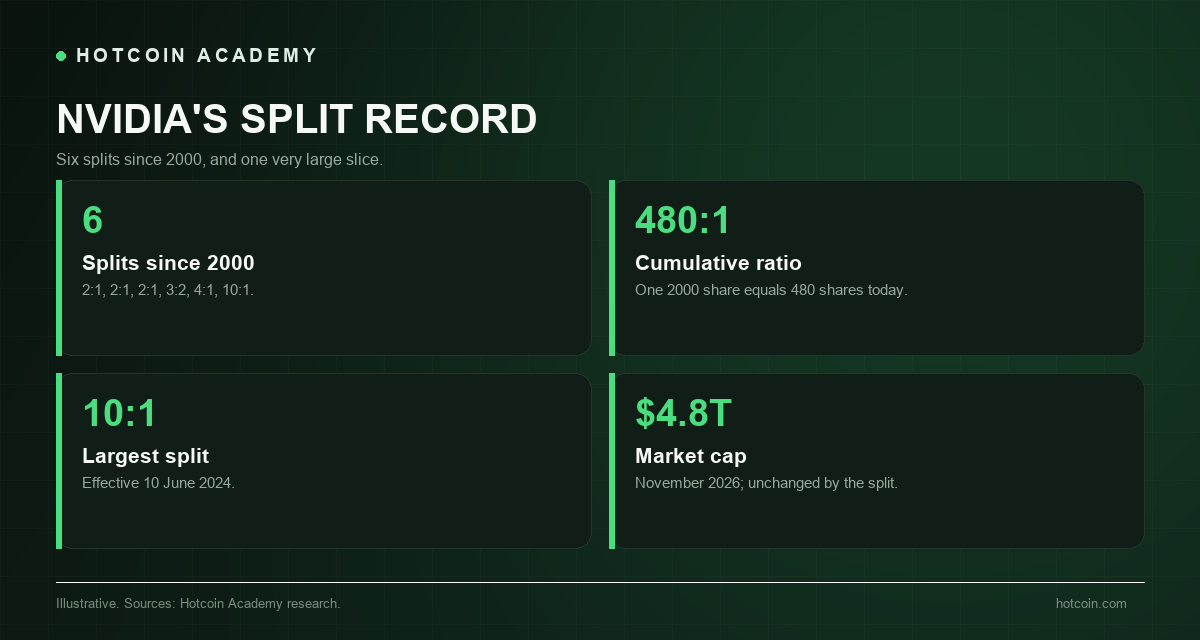
Chart: NVIDIA's six stock splits and the cumulative 480-for-1 ratio.
The 2024 10-for-1 split was announced on May 22 alongside first-quarter earnings, recorded on June 7, and effective on June 10. Before the split the share price was about $1,200; after the split it was about $120. If you held 1 share, it became 10 shares, and the total market value was theoretically unchanged on the split date.
It is worth noting that after NVIDIA's 4-for-1 split in 2021, the share price rose back into four digits driven by the AI wave, which led to the 10-for-1 split in 2024. A stock split is not a signal that "the share price has peaked," nor a guarantee that "the share price will rise"; it is more of an engineering adjustment by the company regarding liquidity, employee compensation, and retail accessibility.
What Did the 10-for-1 Split Change? What Didn't It Change?
Take 1 share at a price of $1,200 as an example: after the split it becomes 10 shares at $120 each, and the position value is still $1,200; the company's total market cap, ownership percentage, voting rights, and total dividends all remain unchanged. This is a simplified example and does not account for trading fees, taxes, or market fluctuations.
| Item | Before the split | After the split |
|---|---|---|
| Shares held | 1 share | 10 shares |
| Price per share | $1,200 | $120 |
| Position value | $1,200 | $1,200 (theoretical) |
| Earnings per share (assuming EPS of $48) | $48 | $4.8 |
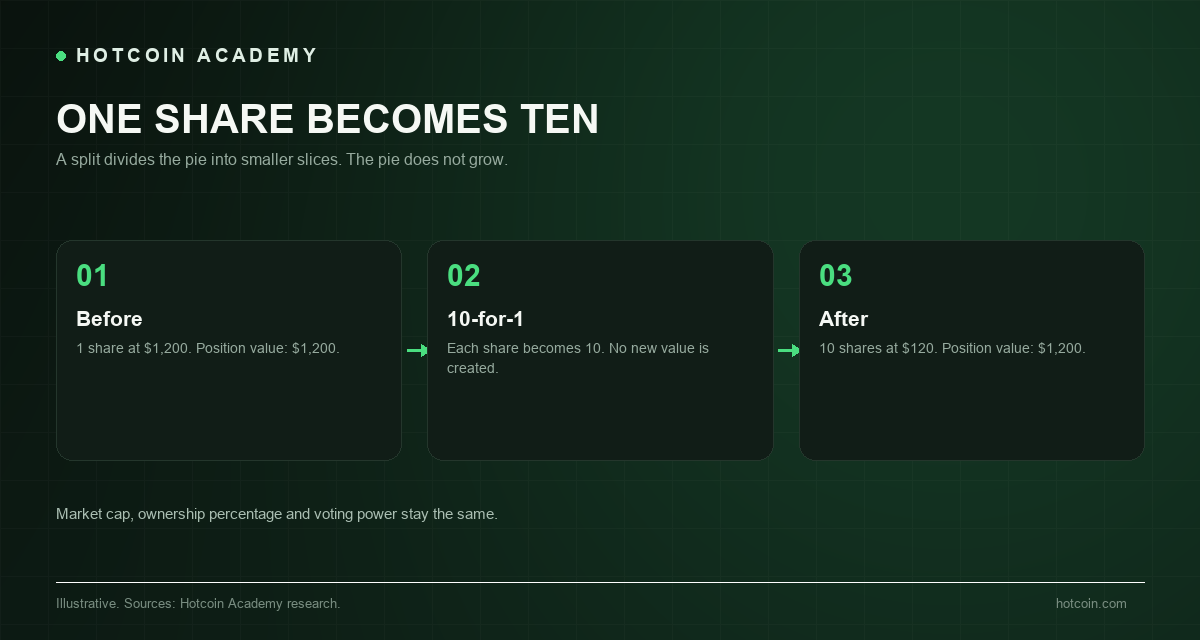
Chart: 1 share at $1,200 becomes 10 shares at $120, with the position value unchanged.
After a split, earnings per share (EPS) becomes one-tenth of its previous level, while the price-to-earnings ratio (P/E) remains unchanged. This is why "a cheaper share price" does not mean "a cheaper valuation": the denominator (earnings per share) shrinks proportionally as well. If the company also raises its dividend, that is a separate dividend policy, not a benefit automatically created by the split.
The Short-Term Impact of a Split on Share Prices: The Announcement Effect
Academic research generally finds positive abnormal returns around split announcements, especially for growth stocks with high retail attention and clear liquidity improvement. There are usually three reasons: first, a split is seen as a signal that management is confident about the outlook; second, a lower nominal share price attracts more retail investors and dollar-cost-averaging funds; third, liquidity improves after the split, and the bid-ask spread may narrow.
After NVIDIA announced its split on May 22, 2024, the share price strengthened in the short term and continued to be driven by AI demand after the June 10 effective date. But it is difficult to attribute this entire gain to the split—during the same period, AI capital expenditure, data center revenue, and the new product cycle were the bigger drivers.
Short-term traders should also watch out for "buy the rumor, sell the news": the market reacts in advance when a split is announced, and profit-taking may occur around the effective date. Treating a split as a short-term catalyst requires factoring in trading volume, options positioning, and overall market sentiment, rather than just the announcement date.
The Long-Term Impact of a Split on Share Prices: Fundamentals Are the Main Character
A stock split does not change a company's cash flow, profit margin, competitive position, or valuation. Long-term share prices are still determined by three things: whether the company can keep growing, whether earnings can be delivered, and how many times those earnings the market is willing to pay. A split simply cuts the same company into more shares; it does not make the company more valuable.
Take NVIDIA as an example: after the 2024 split, the share price rose, driven primarily by an explosion in AI data center demand and revenue and earnings that consistently beat expectations; the pullback in 2026 is likewise related to AI capital expenditure expectations, competition, and valuation, not to "the split failing." As of early November 2026, NVDA was around $181 with a market cap of about $4.8 trillion, still a significant gain from about $120 after the 2024 split, but down some distance from its 2025 high.
In other words, a split offers "an easier price to trade," not "a better business." If you buy because of a split, what you really need to study is the financial statements, orders, competitive landscape, and valuation, not the split ratio.
The Practical Impact on Investors: Fractional Shares, Options, Taxes, and Dividends
- Odd lots and fractional shares: If a split leaves you with less than 1 share, your broker may deposit a fractional share or pay cash in lieu; different brokers handle this differently.
- Options: After a 10-for-1 split, options contracts usually have their strike prices and contract quantities adjusted so that overall economic value is unchanged; actual adjustments are subject to OCC and broker announcements.
- Taxes: The U.S. tax system generally does not treat a split as a taxable disposal; the cost basis is allocated proportionally across the new shares and the holding period continues. Rules in other countries and regions differ, so consult a local tax professional.
- Dividends: The dividend per share is adjusted proportionally, and total dividends remain unchanged; if the company also announces a dividend increase, that is a separate decision.
- Indexes: Market-cap-weighted indexes (such as the S&P 500 and Nasdaq-100) do not change weights because of a split; for the price-weighted Dow Jones Industrial Average, a split changes a stock's relative weight, but the index divisor is adjusted to keep the index level continuous. NVIDIA was added to the Dow in November 2024, so if it splits again in the future, its Dow component weight would be affected.
For long-term investors, the most important practical impact of a split is usually "bookkeeping": you need to confirm that your broker's cost basis, holding period, and fractional share handling are correct. For short-term traders, it is the changes in options contracts and liquidity.
NVIDIA in 2026: Will It Split Again?
As of November 2026, NVIDIA has not announced a new round of stock splits. Every year the market speculates about "the next split," but whether a split happens depends on the share price, employee compensation needs, retail accessibility, and the board's judgment—there is no fixed timetable.
Historically, NVIDIA has split roughly every few years after a large share price rise: 4-for-1 in 2021 and 10-for-1 in 2024. If the share price returns to highs in the future, the company could indeed split again; but treating "a possible split" as a reason to buy is treating a corporate governance event as a fundamental catalyst, which is very risky.
What really matters in 2026 is the sustainability of AI capital expenditure, data center revenue growth, competition (AMD, custom ASICs), export controls, and valuation. A split is just a "technical event" on top of these fundamentals.
Common Misconceptions
- "A split makes the stock cheaper": the share price falls, but earnings per share also falls proportionally, so the P/E ratio is unchanged.
- "A split creates market cap": market cap is determined by share price multiplied by the number of shares; a split changes only those two factors, not the product.
- "The stock always rises after a split": an announcement effect may exist, but it is not guaranteed; many stocks underperform the market over the long term after a split.
- "More shares means more dividends": the dividend per share is adjusted proportionally and total dividends remain unchanged, unless the company separately raises its dividend.
- "A split is a reason to buy": a split does not change the company's earnings, competition, or valuation, and cannot replace fundamental research.
FAQ
How many times has NVDA split? NVIDIA has split its stock six times since 2000: 2-for-1 in 2000, 2001, and 2006; 3-for-2 in 2007; 4-for-1 in 2021; and 10-for-1 in 2024. The cumulative ratio is 480-for-1.
Does a split affect the company's market cap? No. After a split, the share price falls proportionally and the number of shares rises proportionally, so market cap (share price × number of shares) is unchanged. Shareholders' ownership percentage, voting rights, and total dividends are also unchanged.
Do you pay tax on a stock split? Most tax regimes do not treat a split itself as a taxable disposal, but the cost basis and holding period are calculated differently. In the U.S., the cost basis is usually allocated proportionally; for other countries and regions, follow local rules.
What happens to options after a split? Exchanges and clearing organizations adjust options strike prices and contract quantities so that overall economic value remains roughly unchanged. Actual adjustments are subject to OCC and broker announcements, and holders should confirm the contract multiplier and expiration date.
Will NVIDIA split again? As of November 2026, NVIDIA has not announced a new round of stock splits. There is plenty of market speculation, but splits have no fixed timetable and should not be used as a reason to buy.
Will the stock price definitely rise after a split? Not necessarily. A split announcement may bring a positive short-term reaction, but long-term share prices depend on revenue, earnings, valuation, and market sentiment. There are also historical cases of poor long-term performance after a split.
Conclusion
A stock split is an accounting exercise in "slicing a pizza": the pizza does not get bigger, it is just cut into more slices. NVIDIA's 10-for-1 split took its share price from four digits to three digits and made it affordable for more investors, but the company's value, earnings, and risks did not change as a result.
If you follow NVDA, what you should really track is AI demand, revenue growth, competition, and valuation, not rumors about the next split. A split can lower the trading barrier, but it cannot replace fundamental judgment.
Risk disclosure: This article is for educational and informational purposes only and does not constitute investment advice. Trading stocks and options may result in loss of principal; for split, dividend, and tax treatment, please refer to company announcements, your broker, and local regulations.
Inirerekumendang pagbabasa
Tingnan ang higit pa