
What Is WLFI? An Introduction to the World Liberty Financial Token
WLFI is the governance token of World Liberty Financial. The DeFi platform, 38% owned by entities tied to the Trump family, began selling its token in 2024, opened trading in September 2025, and obtained a conditional OCC trust bank charter in 2026 while becoming embroiled in litigation with Justin Sun.
It is not a typical DeFi governance token: its price is shaped simultaneously by product progress, political events, token unlocks, and regulatory news. This article breaks down WLFI's tokenomics, the USD1 stablecoin, and the key events and risks of 2026, so you can see the fundamentals clearly before chasing the hype.
Key Takeaways
- WLFI is the governance token of World Liberty Financial, with a total supply of 100 billion; about 31.8 billion were circulating in November 2026.
- The platform's core product is actually the USD1 stablecoin, with a circulating supply of about $3.76 billion, issued by BitGo and backed by cash and short-term U.S. Treasuries.
- In August 2026, World Liberty Trust Co. obtained a conditional OCC trust bank charter, allowing it to bring stablecoin services in-house.
- Risks are concentrated in politics and regulation, token concentration, unlock-driven selling pressure, and USD1's dependence on growth; WLFI's price has fallen about 80% from its post-launch high.
What Is WLFI? From DeFi Platform to Political Asset
World Liberty Financial (WLFI) is a platform focused on "bridging DeFi and traditional finance." It was launched in September 2024 by Zach Witkoff, Chase Herro, Steve Witkoff, and others, and is closely associated with Donald Trump and his family. The platform initially planned lending, stablecoin, and governance features, and gradually grew into a product suite spanning a governance token, a stablecoin, a lending market, and payment tools.
The WLFI token itself is a governance token, and holders can vote on platform proposals. It is not equity, nor does it represent a claim on the company's assets; its value comes mainly from governance rights, ecosystem incentives, and the market's premium for the "Trump brand." This matters: WLFI's moves often reflect trading in politics and narrative rather than fundamentals.
The platform's relationship with the Trump family is both its defining feature and its biggest controversy. According to CNBC, World Liberty Financial says 38% of the company is held by "entities affiliated with Donald J. Trump and certain family members." This ownership structure has sparked extensive debate over U.S. political ethics and conflicts of interest, and makes WLFI's regulatory risk higher than that of typical DeFi projects.
WLFI Tokenomics: 100 Billion Tokens and the Unlock Mechanism
WLFI's total supply is 100 billion tokens. In October 2024, the platform opened its first sale at $0.015 per token; in 2025 it held an additional sale at $0.05, raising about $550 million in total across the two rounds. On September 1, 2025, WLFI officially opened trading, with only about 20% of supply initially circulating and the rest controlled by governance and unlock schedules.
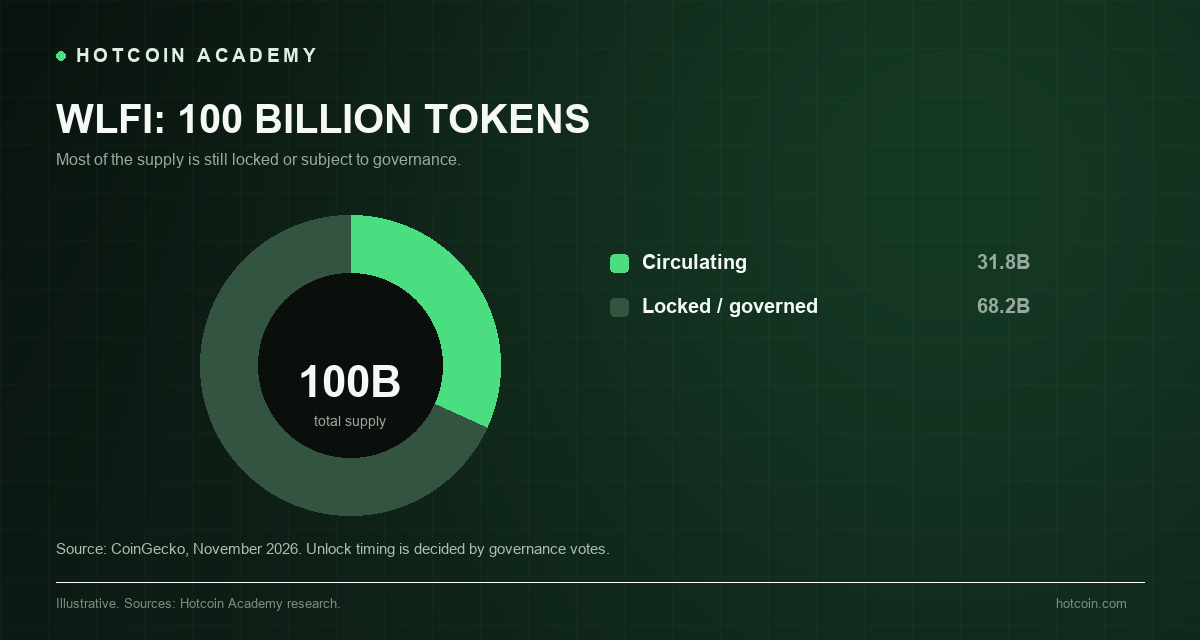
Chart: Of WLFI's 100 billion token supply, about 30% was circulating in November 2026.
| Item | Data | Notes |
|---|---|---|
| Token name | WLFI | World Liberty Financial governance token |
| Total supply | 100 billion tokens | Fixed cap, no inflation design |
| Circulating supply | About 31.8 billion tokens | November 2026, about 31.8% of total |
| Initial sale price | $0.015 | October 2024 |
| Second-round price | $0.05 | 2025 follow-on sale |
| Amount raised | About $550 million | Combined across two rounds |
| Trading launch | September 1, 2025 | Transfers and trading opened |
| Unlock method | Determined by governance vote | The remaining ~80% is released per proposals and schedules |
Data from official announcements, CoinGecko, and public reports; circulating supply changes with unlocks.
Unlocks are one of the most important sources of price pressure on WLFI. When a governance proposal approves a new unlock, the market expects supply to increase, and the price often reacts in advance. In March 2026, WLFI fell after a 135 million token unlock and a yield adjustment. For holders, tracking governance proposals and unlock schedules is more practical than watching short-term prices.
USD1: WLFI's True Core Product
If WLFI is the governance token, USD1 is the ecosystem's cash layer. Launched in March 2025, USD1 is pegged 1:1 to the U.S. dollar, backed mainly by cash and short-term U.S. Treasuries, and initially issued and custodied by BitGo. Its goal is not to become another USDT but to serve as a settlement tool for the WLFI ecosystem, institutional payments, and RWA use cases.
In November 2026, USD1's circulating supply was about $3.76 billion, ranking roughly 30th among stablecoins. That is still small compared with USDT's $178 billion and USDC's $70.6 billion, but it is growing fast and is tied to campaigns on exchanges such as Binance. At the end of 2025, Binance Earn offered up to 20% annualized rewards on USD1, a means of attracting capital.
In August 2026, the OCC conditionally approved a national trust bank charter for World Liberty Trust Co. This allows World Liberty to move some stablecoin services from third parties such as BitGo back in-house, and brings USD1 closer to being "regulated payment infrastructure." For WLFI holders, USD1 adoption supports the long-term narrative more than WLFI's governance features do.
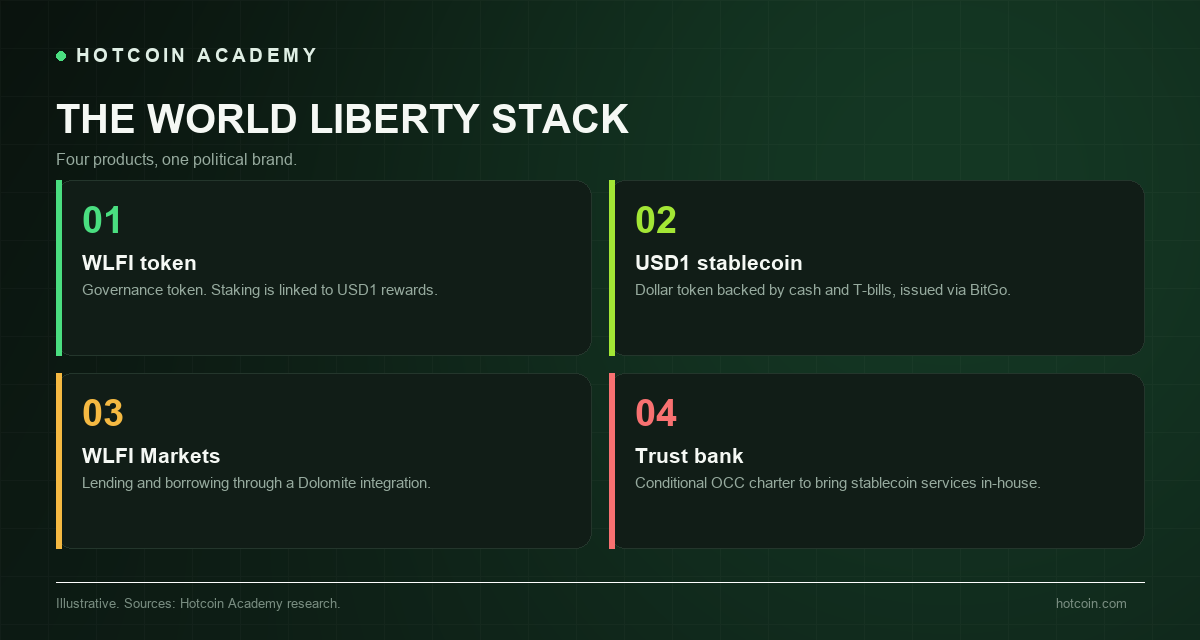
Chart: World Liberty's four product layers: governance token, stablecoin, lending market, and trust bank.
What Happened in 2026? Bank Charter, Litigation, and Price Pressure
2026 was the year WLFI moved from "hype coin" toward "regulated asset," and also the year disputes erupted in force.
- August: OCC conditionally approves trust bank charter: World Liberty Trust Co. can issue and manage stablecoins, reducing reliance on BitGo and raising compliance thresholds.
- April: Justin Sun files lawsuit: Sun claims he bought WLFI for $45 million but the platform froze his tokens; World Liberty says the freeze was justified.
- November: Sun seeks sanctions: Sun alleges World Liberty disclosed UAE-related holdings only months after the lawsuit, and on that basis argues the federal court lacks jurisdiction; World Liberty denies deliberately concealing information.
- All year: price and unlock pressure: WLFI fell about 80% from its post-launch high, trading around $0.05 in November 2026.
These events intertwine, making WLFI's price hard to explain through "fundamentals" alone. The bank charter is a long-term positive, while the lawsuit and political controversy are short-term negatives; with both present at once, volatility naturally amplifies.
WLFI Risks: Politics, Concentration, Unlocks, and Regulation
WLFI's risks are more complex than those of a typical DeFi token because it is exposed on three fronts at once: politics, regulation, and product.
| Risk | Details | Impact on Price |
|---|---|---|
| Political risk | Close ties to the Trump family; policy and election changes affect the narrative | Event-driven, amplified volatility |
| Regulatory risk | Bank charter, stablecoin regulation, foreign ownership disclosure, and conflict-of-interest investigations | Higher compliance costs, headlines dominate |
| Token concentration | Early investors, the team, and affiliated entities hold large amounts of low-cost tokens | Unlock and sell-off pressure |
| Product dependence | USD1 adoption and yield subsidies determine ecosystem momentum | Valuation correction if growth disappoints |
| Legal risk | Justin Sun lawsuit, shareholder and consumer class actions | Uncertainty discount |
Risks compiled from public reports; some cases are still developing.
There is also a structural issue: WLFI's governance rights and economic interests are asymmetric. Token holders can vote, but platform revenue, USD1 reserves, and brand value are mainly controlled by the company and affiliated entities. This does not mean the token has no value, but investors should be clear that they are buying "governance and narrative," not "cash flow."
How to Buy and Evaluate WLFI
WLFI is listed on several centralized exchanges, including spot trading pairs on Hotcoin. Before buying, confirm the trading pair, fees, and deposit/withdrawal methods, and note that WLFI's price depth is relatively thin compared with major coins, so large trades may cause noticeable slippage.
- Watch USD1 supply: USD1 is the core of the WLFI ecosystem; growth in supply and use cases reflects fundamentals better than daily price.
- Watch governance proposals: Unlocks, yield subsidies, and treasury fund usage all affect supply and demand; volatility often peaks around proposal votes.
- Watch legal developments: The Justin Sun lawsuit, UAE ownership disclosures, and political ethics investigations all change how the market prices regulatory risk.
- Watch the unlock schedule: Added circulating supply directly increases selling pressure, especially low-cost tokens.
If you are trading short-term, you must treat political news and unlock events as trading variables; if you plan to hold long-term, you need to answer one question: without cash flow, what ultimately supports WLFI's value? For now, the most reasonable answer is USD1 adoption and World Liberty's regulatory standing, not the token itself.
Common Misconceptions
- "WLFI is USD1": They are different assets; WLFI is a governance token and USD1 is a stablecoin.
- "A bank charter means the price must rise": Regulatory progress is a long-term positive, but unlocks and litigation still weigh on the short term.
- "The Trump brand means safety": The brand brings attention, but also political and regulatory risk.
- "An 80% drop means a bottom": Until unlocks and litigation are resolved, there is no guaranteed bottom.
FAQ
What is the difference between WLFI and USD1? WLFI is the governance token of World Liberty Financial and its price fluctuates; USD1 is a stablecoin pegged 1:1 to the U.S. dollar for payments and settlement. They belong to the same ecosystem but carry entirely different risks and uses.
How many WLFI tokens are there in total? Total supply is 100 billion. About 31.8 billion were circulating in November 2026, with the rest released per governance proposals and unlock schedules.
Why has WLFI fallen so much from its high? The main pressures are token unlocks, USD1 growth falling short of expectations, the Justin Sun lawsuit, and political controversy. The crypto market was also in a correction phase in 2026, further amplifying the decline.
What is World Liberty's bank charter? In August 2026, the OCC conditionally approved a national trust bank charter for World Liberty Trust Co., enabling it to issue and manage stablecoins more directly and reducing reliance on third-party custody.
Can WLFI be staked? The official platform offers WLFI staking and governance participation, with some campaigns rewarding in USD1. Before staking, confirm the lock-up rules, smart contract risks, and reward sources.
Conclusion
WLFI is an experiment that ties together a political brand, DeFi governance, and stablecoin infrastructure. Its product roadmap is clear, but value capture is unclear; its narrative is strong, but its risks are concentrated.
If you want to track WLFI, look beyond price to USD1 supply, governance proposals, and legal developments. For real-time quotes and trading pairs, see Hotcoin's WLFI price page.
Risk disclaimer: This article is for educational and informational purposes only and does not constitute investment advice. WLFI and USD1 involve political, regulatory, legal, and market risks; prices may be highly volatile, and investors may lose their entire principal.
Inirerekumendang pagbabasa
Tingnan ang higit pa